
 X (Twitter)
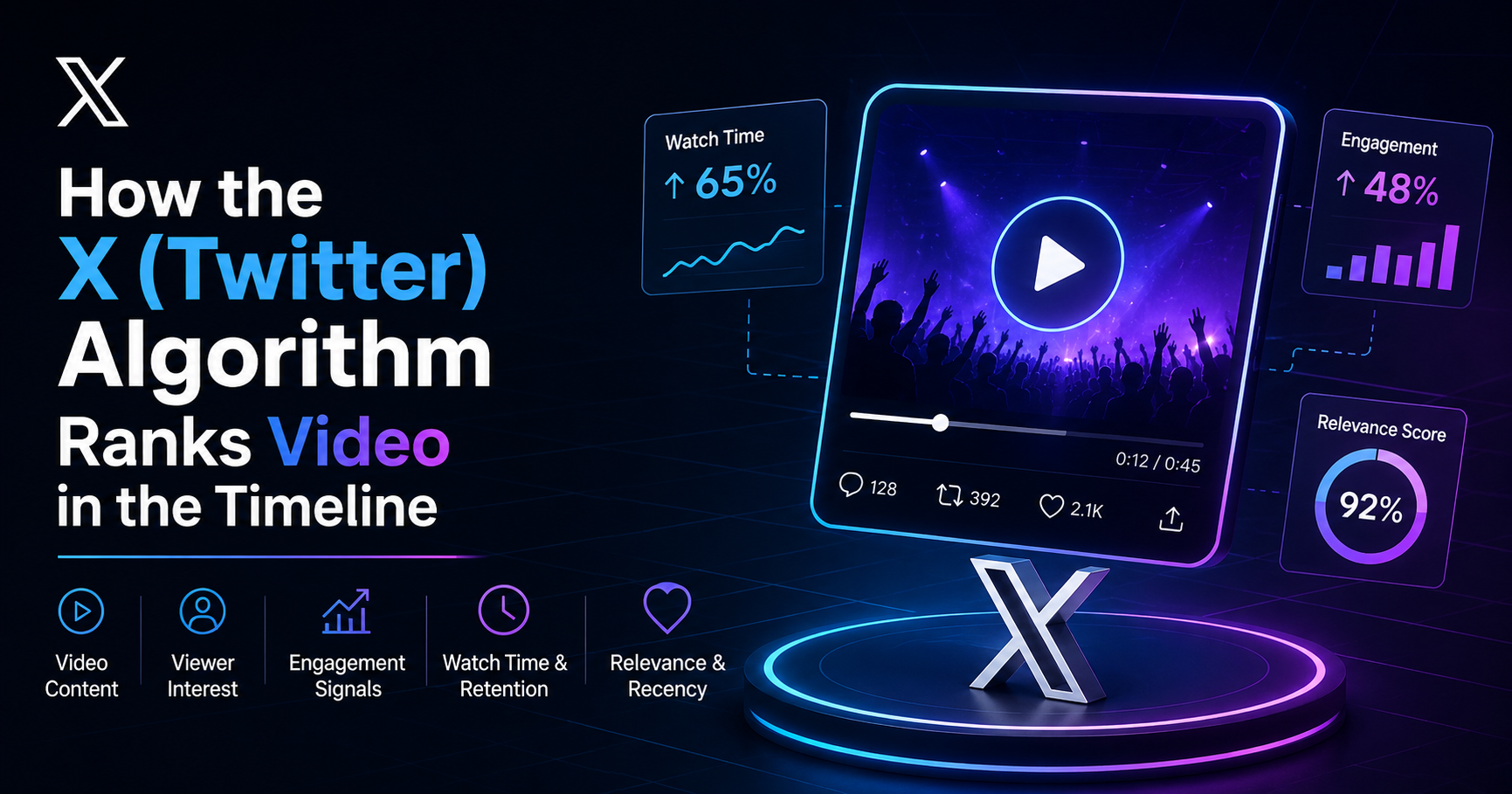
How the X (Twitter) Algorithm Ranks Video in the Timeline
Video on X (formerly Twitter) behaves differently from text or image posts. It plays inline as people scroll, competes with a fast-moving feed, and is distributed both to followers and to people who have never heard of you. Understanding how video content is surfaced in the timeline helps you publish with intent instead of guessing.
This article explains what is reasonably known about video distribution on X, clearly separating observed platform behavior from general creator best practices. X does not publish a complete ranking formula, so nothing here — or anywhere else — should be treated as a guaranteed recipe for reach.
How video content appears in the X timeline
Video can surface in several distinct places, and each has different distribution logic:
- Following timeline — posts from accounts a user follows, shown roughly in reverse-chronological order. Your existing followers are the primary audience here.
- For You timeline — a recommendation feed that mixes followed accounts with content X predicts a user will find relevant. This is where videos from accounts you don't follow can appear.
- Video tab / immersive player — a dedicated vertical video feed in the X app where videos are consumed full-screen, similar in spirit to other short-video feeds.
- Search and trending surfaces — videos attached to trending topics or matching search queries can gain additional exposure.
For most creators, the biggest growth opportunity is the For You feed, because that is where videos are shown to non-followers.
What factors can influence distribution and visibility
Based on X's public statements and the recommendation code it has open-sourced, distribution is influenced by predicted engagement — the system's estimate of how likely a viewer is to watch, like, reply, repost, or share. Factors that can contribute include:
- Viewer behavior on similar content — people who watch videos like yours are more likely to be shown your video.
- Early engagement — strong interaction shortly after posting can help the system test the video with wider audiences.
- Watch behavior — whether viewers keep watching or swipe away quickly is a meaningful signal for video specifically.
- Replies and shares — replies and reposts tend to weigh more heavily than passive likes because they indicate active interest.
- Author reputation and account standing — accounts in good standing with authentic engagement patterns are distributed more reliably than accounts flagged for spam-like behavior.
None of these alone guarantees distribution, and no specific engagement number unlocks the algorithm. Distribution is probabilistic, not a threshold you cross.
Why relevance and viewer behavior matter
The For You feed is fundamentally a matching system: it tries to pair each video with the viewers most likely to care about it. That means relevance — how clearly your video fits an identifiable interest — matters as much as raw quality.
A video about a specific topic (a game, a skill, a news event, a niche hobby) gives the system clear signals about who should see it. A vague video with no identifiable topic is harder to match, so it is often shown to fewer people even if it is well produced.
How video engagement differs from text and image posts
Text posts are consumed almost instantly, so the main signals are likes, replies, and reposts. Video adds a time dimension: the platform can observe how long people watch, where they drop off, and whether they expand the video to full screen or enable sound.
This means a video can underperform even with decent likes if most viewers abandon it in the first seconds — and conversely, a video with modest like counts can keep being distributed if viewers consistently watch it through. Retention is a video-specific signal that simply doesn't exist for a text post.
Why the opening seconds and clear context matter
In a scrolling feed, viewers make a keep-or-skip decision almost immediately. The first few seconds of a video therefore carry disproportionate weight:
- Lead with the most interesting moment or the core question — not a logo, intro, or slow build-up.
- Make the video understandable without sound, since many viewers scroll muted. On-screen text or captions set context instantly.
- The post text around the video also frames expectations. A clear one-line description tells both viewers and the relevance system what the video is about.
How to improve your videos organically
These are general creator best practices, not an official formula:
- Pick a clear topic per video — one idea, clearly delivered, is easier to match with the right audience.
- Hook early — put the payoff, surprise, or question in the first seconds.
- Keep it as short as the idea allows — completion rate matters more than absolute length.
- Write descriptive post text — help search and relevance systems categorize the video.
- Post natively — upload video directly to X rather than linking out to another platform; native video plays inline and is far more likely to be watched.
- Be consistent — regular posting builds the follower base that generates early engagement, which in turn supports wider testing.
- Reply to your own video's comments — active threads can extend a post's visibility window.
Common mistakes that reduce video engagement
- Slow intros — branding bumpers and long setups burn the exact seconds that decide retention.
- Cross-posted links instead of native uploads — external links don't autoplay and usually earn far fewer views.
- No captions or on-screen text — muted viewers skip videos they can't understand.
- Vague topics — content that could be about anything is matched with no one in particular.
- Posting and disappearing — ignoring early replies wastes the engagement window.
- Chasing raw view counts over retention — a view count without watch time is a weak signal.
Some creators also explore paid options to strengthen early social proof on important videos. If you go that route, treat it as a supplement to strong content, never a substitute: while you can buy X/Twitter video views to make a video look more established, views are at most one engagement signal among many — they cannot guarantee ranking, timeline placement, or viral reach, and no service can guarantee impressions or algorithmic distribution.
What to monitor when evaluating video performance
X's analytics give you the data that actually reflects distribution quality:
- Views and impressions — the raw reach of the video.
- Watch time and completion rate — whether people actually watch; the most informative video metric.
- Engagement rate — likes, replies, reposts and bookmarks relative to impressions.
- Profile visits and follows from the video — whether the content converts viewers into followers.
- Drop-off patterns — where viewers leave tells you what to fix in the next video.
Judge videos on 7–28 day trends rather than the first hours, and compare like-for-like: the same format, length and topic, so you can tell what actually caused a difference. If the view number itself is unclear — or a count seems stuck — our companion explainer covers what counts as a video view on X and the common reasons counts stall.
Conclusion
Video on X is distributed through a relevance-matching system that weighs predicted engagement, watch behavior, and early interaction. There is no public ranking formula and no engagement number that guarantees placement. What you can control is clarity of topic, a strong opening, native uploads, descriptive text, and consistency — the inputs that give the system every reason to show your video to the right people. Measure retention and engagement rate, iterate on what holds attention, and treat any paid support as a small boost on top of content that already deserves to be watched.
Frequently asked questions
Does X have an official video ranking formula?
No. X does not publish a complete ranking formula for video. What we know comes from platform announcements, the parts of the recommendation code X has open-sourced, and observed creator behavior. Everything else is best practice, not a guaranteed formula.
Do longer videos rank better on X?
Not automatically. What matters is how much of the video people actually watch. A short video that most viewers finish can outperform a long video that viewers abandon after a few seconds. Match the length to the idea, not to a target duration.
Do hashtags help videos get distributed on X?
Hashtags play a much smaller role on X than on other platforms. Clear text in the post itself — describing what the video is about — matters more for search and relevance matching than a string of hashtags.
Does buying X/Twitter video views guarantee timeline ranking?
No. Buying views cannot guarantee ranking, timeline placement, or viral reach. View counts are at most one engagement signal among many, and no service can guarantee impressions, reach, or algorithmic distribution.
Ready to grow your Social Media?
Safe, drip-fed delivery — no password required. Compare all pricing, browse more growth guides, or contact support with any question.
Start Growing